For Journalists and Policymakers
Covering student loans, repayment, or borrower experiences?
This website was built to help journalists and policymakers move beyond monthly-payment calculations and understand how today's student-loan system affects borrowers' financial well-being, mental health, trust, and ability to plan for the future. It combines 1,810 survey records with interviews from 67 student-loan borrowers enrolled in income-driven repayment plans, connecting public-facing findings with the experiences behind them.
What makes this data different?
The balance is only the visible part.
Most student-loan reporting understandably focuses on payment amounts, balances, forgiveness totals, and federal policy. This project also asks how uncertainty surrounding repayment programs enters borrowers' lives.
Across the interviews, borrowers repeatedly described delaying or reshaping:
- Buying a home
- Starting or expanding families
- Career changes
- Retirement and savings plans
- Other major financial decisions
The recurring issue was not simply what borrowers owed today, but whether today's rules would still exist tomorrow.
Explore the data
Build the comparison your story needs.
- Compare one or two borrower characteristics
- Explore 30 survey outcomes
- Generate custom bar charts and Sankey diagrams
- Download figures with exact-data tables and notes
- Examine relationships across multiple characteristics
Recent findings
Evidence worth a closer look
Use the controls to move through timely quantitative and qualitative findings. Contact Daniel for context, interpretation, or a tailored data briefing.
Financial cushions
60.6%reported no money in general investments outside retirement accounts.
The median was $0 and the mean was $15,277 among 1,380 valid responses, illustrating a strongly right-skewed distribution. Retirement and general savings are separate measures.
Survey estimates are unweighted, descriptive, and based on available responses; denominators vary by question. They should not be interpreted as causal or nationally representative. Read the full methodology.
Story ideas from the data
Five reporting angles to pursue
These prompts are starting points, not predetermined conclusions. The explorer, interview themes, and direct research support can help test and sharpen each angle.
Which borrowers report the greatest psychological distress?
Explore distress →What changes after borrowers receive loan forgiveness?
Explore forgiveness →Why does homeownership differ across repayment experiences?
Compare homeownership →How does trust in government shape the repayment experience?
Follow the theme →Downloadable media kit
Figures ready for your reporting workflow
Download the complete package—including four figures, the research summary, and a professional headshot—or select an individual asset below.
Download complete kit · ZIP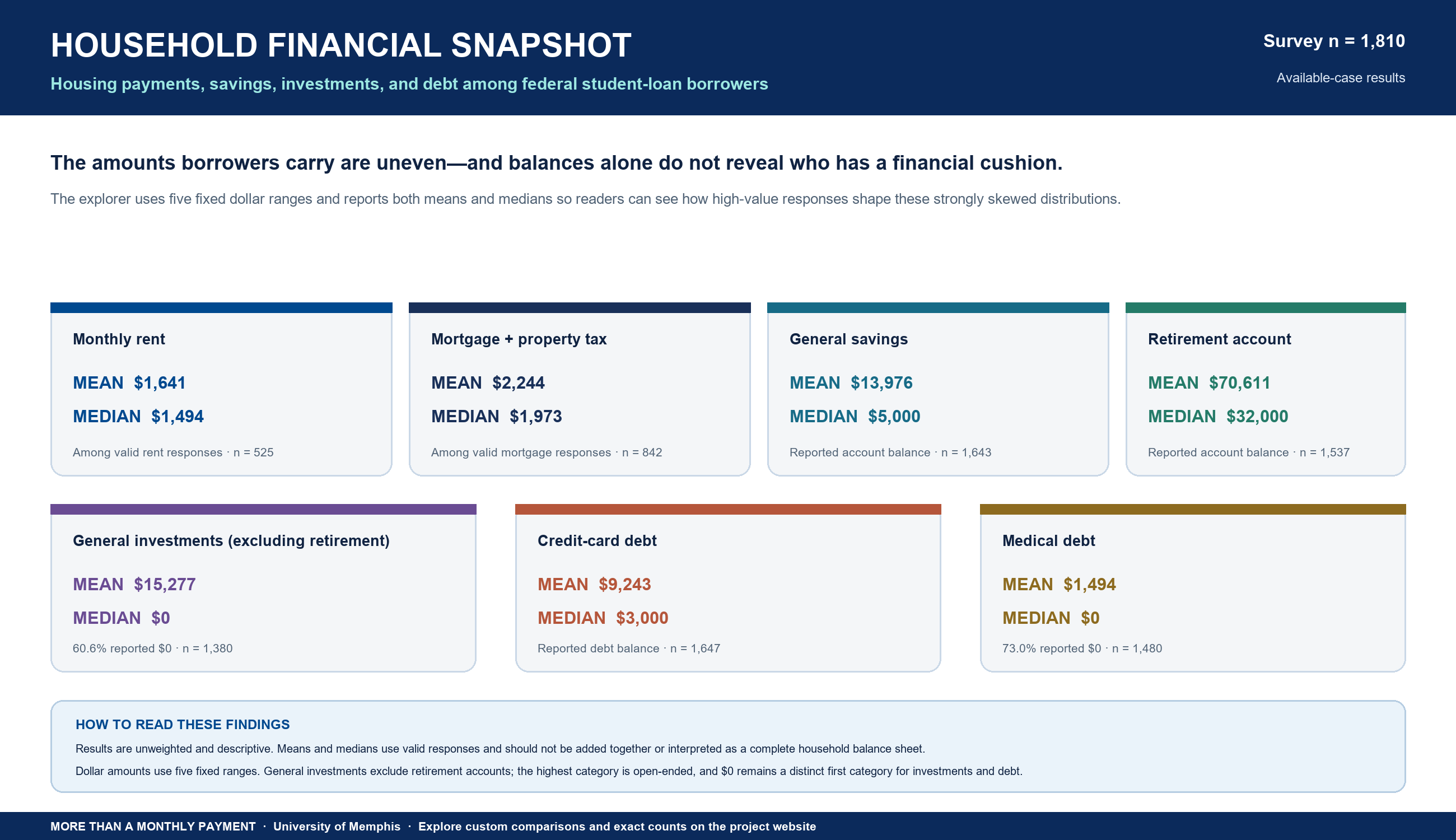
PNG figure
Household financial snapshot
A press-ready overview of mean and median monthly housing payments, savings, retirement, investments, credit-card debt, and medical debt.
Download figure ↓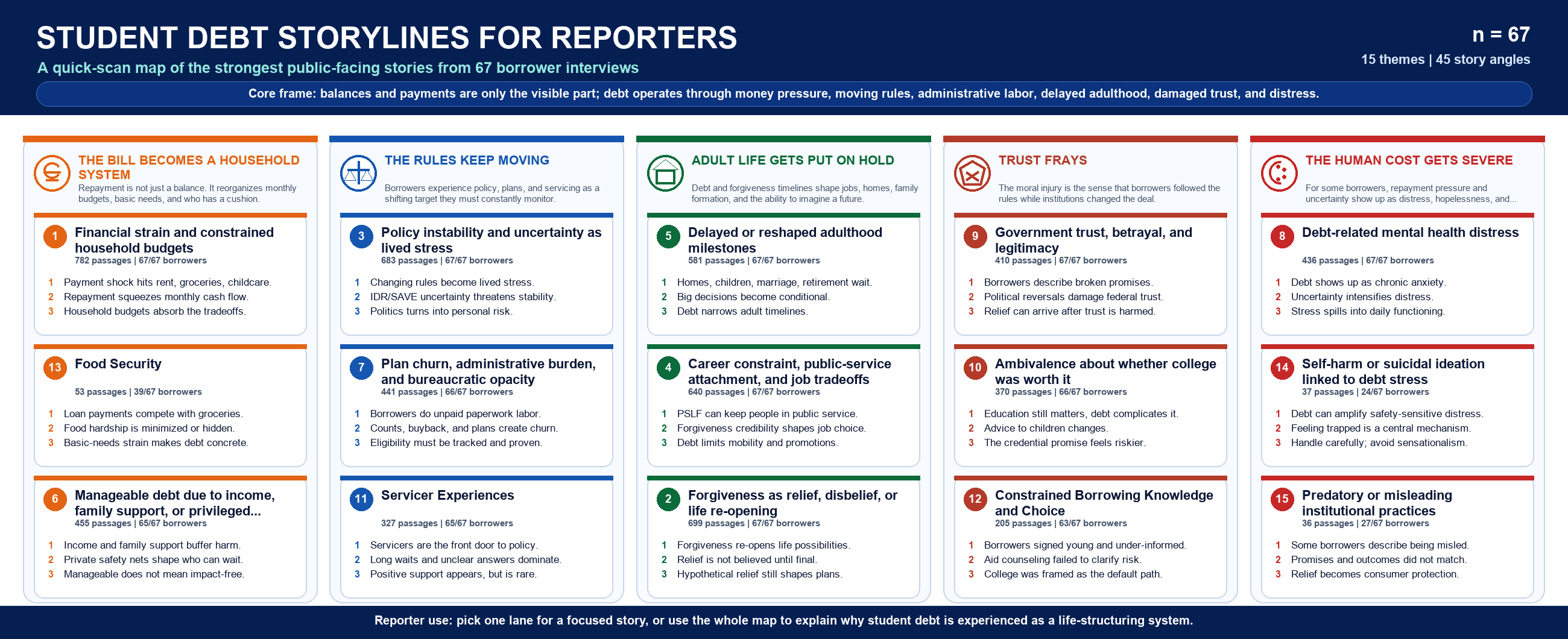
PNG figure
Media quick guide
A quick-scan map of the strongest public-facing storylines from 67 borrower interviews, updated after human adjudication of the servicer-support coding.
Download figure ↓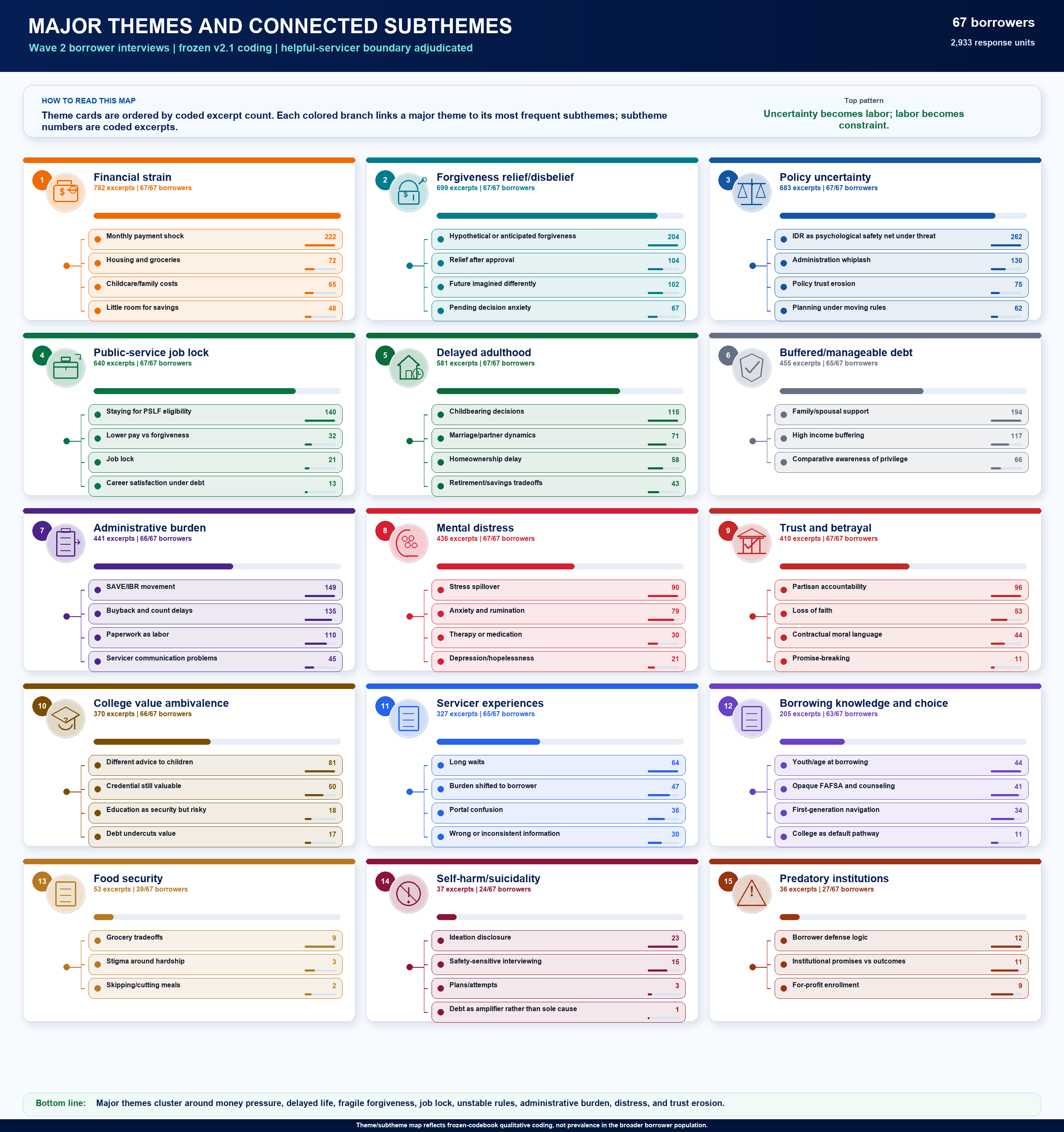
PNG figure
Major themes and subthemes
A visual guide to all 15 analytic themes and their most frequently connected subthemes, including the corrected servicer-experience pattern.
Download figure ↓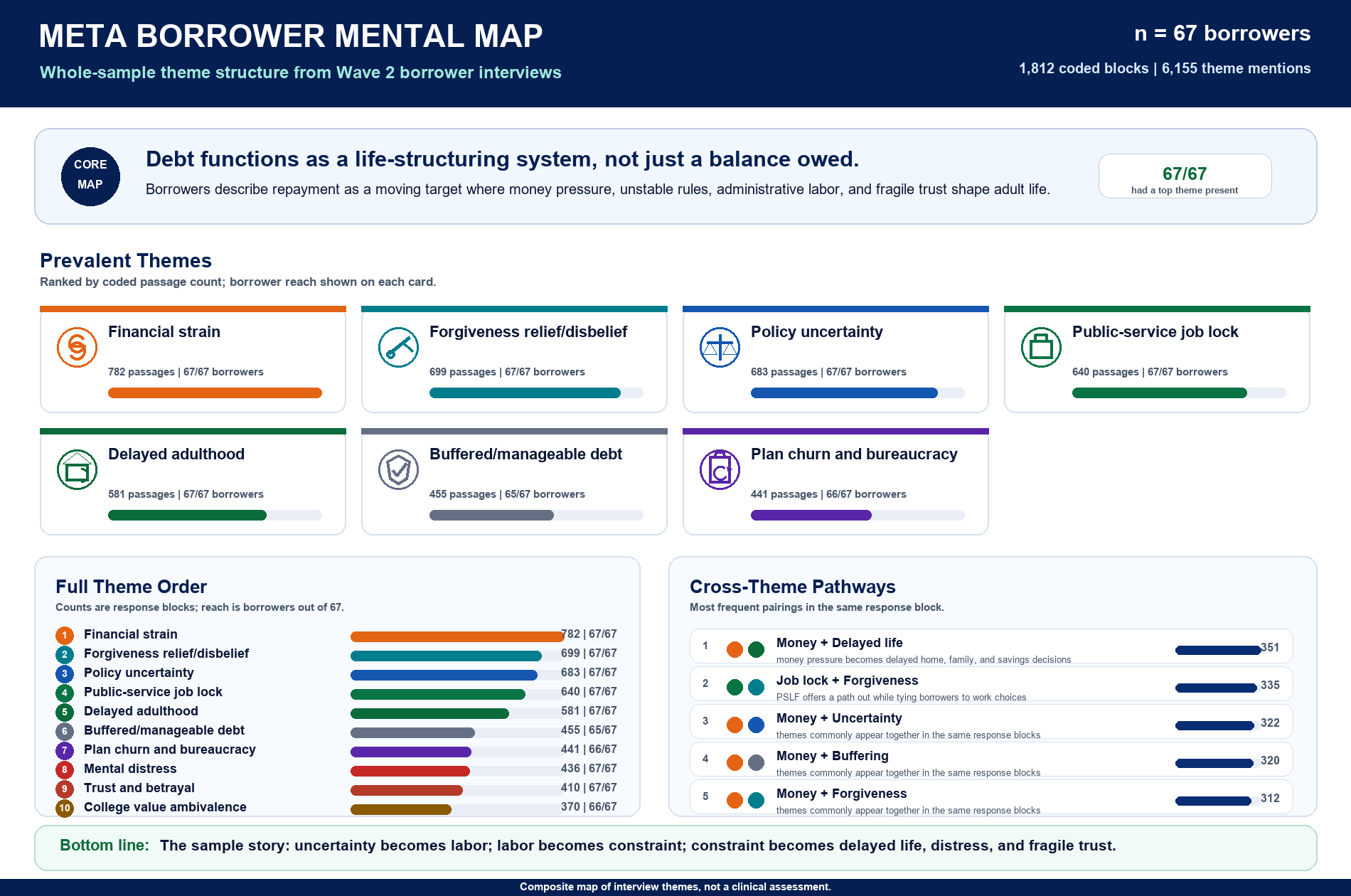
PNG figure
Meta borrower mental map
A whole-sample view of prevalent interview themes and the pathways that connect them.
Download figure ↓Research summaryDownload PDF ↓Public findings workbookDownload XLSX ↓Citations and reuse notesView downloads page →
Additional resources
Background for a deadline—or a deeper dive

Research expert
Daniel A. Collier, Ph.D.
Daniel studies how higher-education finance and public policy shape borrowers’ financial security, well-being, and life choices.
He can speak with reporters about student-loan repayment, Income-Driven Repayment, Public Service Loan Forgiveness, administrative burden, policy uncertainty, student basic needs, and the human consequences of student debt.
Research areas
Student-loan debt · PSLF · Income-Driven Repayment · Administrative burden · Higher-education finance · Financial well-being · Mental health · Student success
Available for
- Breaking-news response
- Television and radio
- Podcasts and presentations
- Background conversations
- Data interpretation
- Research summaries