PNG · survey snapshot
Household Financial Snapshot
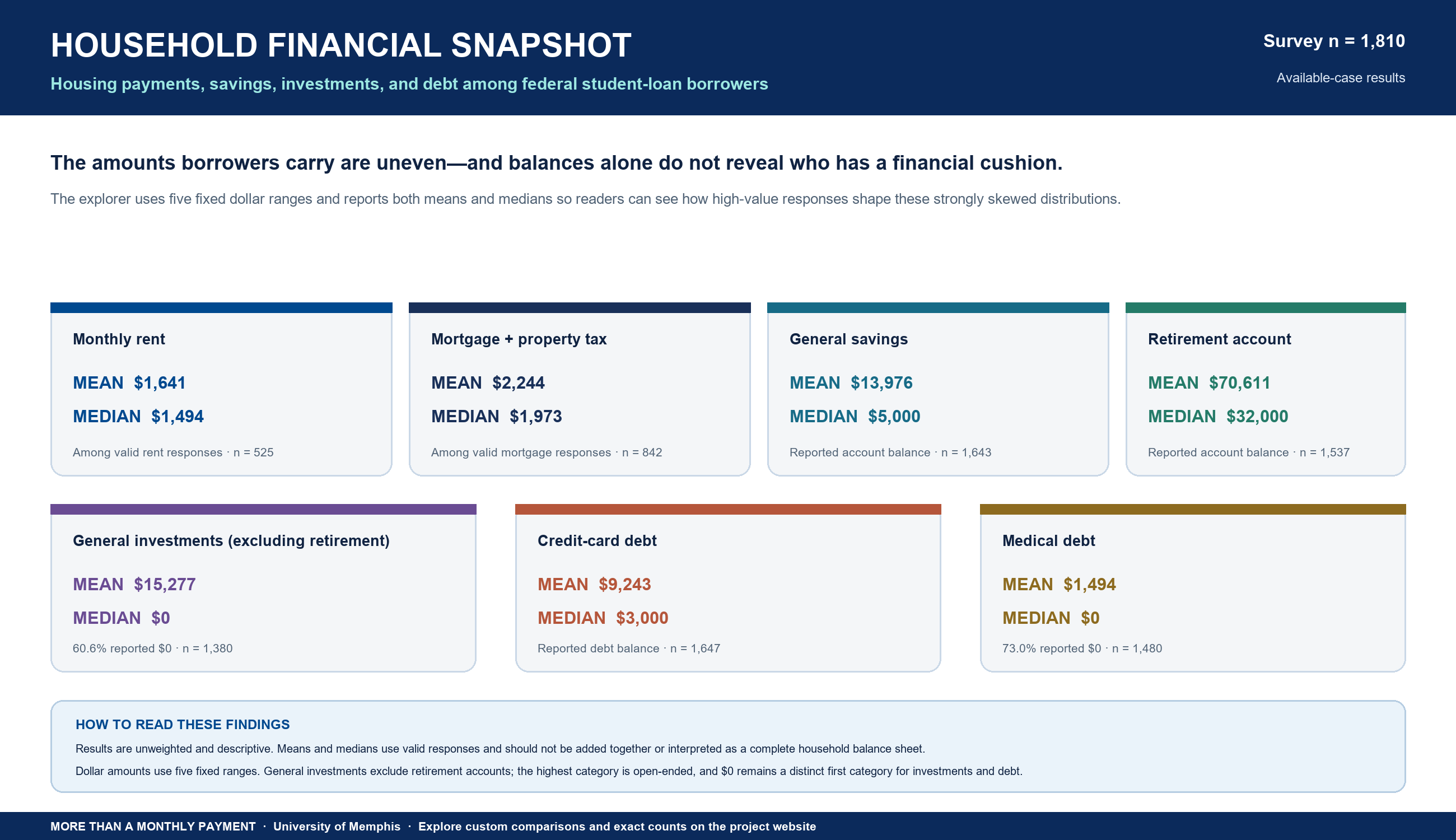
Mean and median housing payments, account balances, and debts, plus the shares reporting no general investments outside retirement accounts or no medical debt.
Interactive survey findings
Choose one of thirty outcomes to view the full sample, or compare it across one or two of twenty-two participant characteristics. Build detailed crosstabs or use the Sankey module to connect starting and ending variables with a third line-weight variable. Small categories remain available with cautions for interpretation.
Selected comparison
Agreement that college was worth it for the respondent.
Exact survey question: To which extent do you agree with the following statements - College was worth it for me
| Group | Strongly Disagree | Disagree | Neither Disagree or Agree | Agree | Strongly Agree | Valid n | Caution |
|---|---|---|---|---|---|---|---|
| 18–29 | 8.5% (14) | 17.0% (28) | 26.7% (44) | 33.3% (55) | 14.5% (24) | 165 | — |
| 30–39 | 4.9% (30) | 7.3% (45) | 14.6% (90) | 40.2% (248) | 33.1% (204) | 617 | — |
| 40–49 | 5.1% (28) | 6.2% (34) | 15.2% (83) | 31.8% (174) | 41.7% (228) | 547 | — |
| 50–59 | 3.3% (7) | 5.7% (12) | 8.1% (17) | 30.8% (65) | 52.1% (110) | 211 | — |
| 60+ | 6.3% (8) | 5.5% (7) | 11.0% (14) | 31.5% (40) | 45.7% (58) | 127 | — |
How to read this: Results are unweighted and descriptive. They do not establish causation or indicate that differences are statistically significant.
Percentages and averages use valid responses for the selected outcome; denominators therefore vary. Interview quotations elsewhere on this site provide context and are not assigned to demographic subgroups selected here.
Build a weighted relationship
Choose a starting variable and an ending variable, then choose a third variable to weight the connections. Each line is divided by the weight variable’s categories, and its thickness shows the number of respondents in that category.
| From | To | Suicidal Ideation | Respondents | Percent of complete records | Caution |
|---|---|---|---|---|---|
| High security | Moderate Distress | No | 520 | 32.4% | — |
| High security | No/Low Distress | No | 287 | 17.9% | — |
| High security | Serious Distress | No | 134 | 8.3% | — |
| Very low security | Serious Distress | Yes | 99 | 6.2% | — |
| Very low security | Serious Distress | No | 87 | 5.4% | — |
| Low security | Moderate Distress | No | 80 | 5.0% | — |
| Low security | Serious Distress | Yes | 68 | 4.2% | — |
| Low security | Serious Distress | No | 61 | 3.8% | — |
| High security | Serious Distress | Yes | 55 | 3.4% | — |
| Marginal security | Moderate Distress | No | 46 | 2.9% | — |
| High security | Moderate Distress | Yes | 45 | 2.8% | — |
| Very low security | Moderate Distress | No | 39 | 2.4% | — |
| Marginal security | Serious Distress | No | 33 | 2.1% | — |
| Very low security | Moderate Distress | Yes | 11 | 0.7% | Small sample |
| Marginal security | Serious Distress | Yes | 11 | 0.7% | Small sample |
| Low security | Moderate Distress | Yes | 8 | 0.5% | Small sample |
| Marginal security | No/Low Distress | No | 8 | 0.5% | Small sample |
| Low security | No/Low Distress | No | 6 | 0.4% | Small sample |
| High security | No/Low Distress | Yes | 3 | 0.2% | Small sample |
| Marginal security | Moderate Distress | Yes | 3 | 0.2% | Small sample |
| Very low security | No/Low Distress | No | 1 | 0.1% | Small sample |
Node order: Starting and ending categories are arranged from the highest selected value at the top to the lowest at the bottom. Percentages use the included-record denominator.
Included records: 1,605 respondents have valid values for all three variables and match the selected weight categories.
Interpretation and caution: Color identifies the weight category and line thickness represents its respondent count; neither implies causation or time order. An asterisk marks a node with n≤15. Dashed connections also contain n≤15. These small-sample results may be unstable and should be interpreted cautiously.
Downloadable survey visual
A press-ready overview of seven financial measures, with means, medians, valid response counts, and interpretation notes.
PNG · survey snapshot
Mean and median housing payments, account balances, and debts, plus the shares reporting no general investments outside retirement accounts or no medical debt.